Service

Strength Training While You Are on a GLP-1

The weight is coming off. The trials behind these medications did not include a plan for your strength. We measure first, then build a strength program around your body, one-on-one with a Doctor of Physical Therapy. Your medication stays with your prescriber.

What the trials found

GLP-1 medications such as semaglutide (Wegovy, Ozempic) and tirzepatide (Zepbound, Mounjaro) are now part of everyday life. About one in ten American adults reported taking one in the past year, according to CDC survey data collected in 2025, and among adults 40 to 64 it was closer to one in seven.

When weight comes off, it is not all fat. In the main semaglutide trial, a body scan substudy of 140 people found that those on the medication lost an average of about 18 pounds of fat and about 12 pounds of lean mass over 68 weeks. In the main tirzepatide trial, about three quarters of the weight people lost was fat and about one quarter was lean mass, and the split was the same in the placebo group.

Lean mass is not the same thing as muscle. On a body scan it is everything that is not fat or bone mineral, so it counts muscle along with organs and fluid. A 2025 joint advisory from four US medical and nutrition societies estimates that muscle is about half of lean mass. So the line you may have heard, that 40 percent of the weight you lose is muscle, overstates it.

Two more things from the same trials. Some loss of lean mass is expected with any substantial weight reduction, with or without medication. And people on the medications reported better physical function on average, on questionnaires, even though their lean mass went down.

We do not prescribe or advise on medication. Whether to start, stop or change one is a decision for you and your prescriber. Our part is your strength, and we do it alongside them.

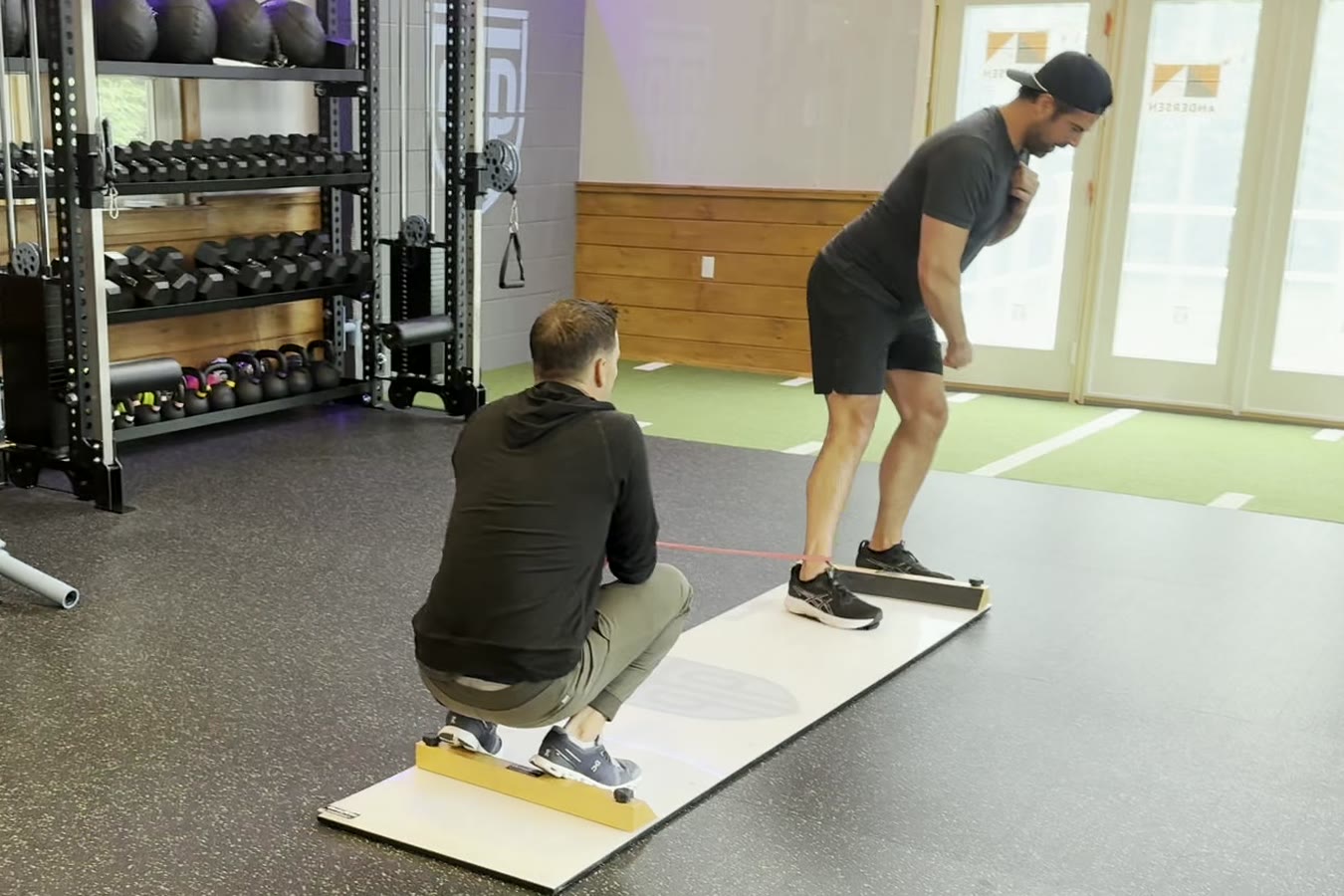
A PT Progression clinician crouches beside a client on the slide board, watching how he moves, with the turf strip behind them

Why strength is the part to plan for

The medication and your prescriber handle the weight. Nobody in the trials was handed a plan for strength. Here is what the evidence says about that gap.

The trials had no strength program

Participants in both main trials were encouraged to be active for 150 minutes a week. In the semaglutide trial the example given was walking. Neither trial included a strength training program, so the numbers above describe weight loss without one.

What four societies advise

A 2025 joint advisory from four US medical and nutrition societies says these medications should be prescribed together with a structured exercise program, aiming for regular strength training at least three times a week plus aerobic exercise. It adds that extra protein alone is likely not enough.

What dieting studies show

In a trial of 160 older adults with obesity, the dieting groups that did resistance training lost less lean mass and less hip bone density than the dieting group that did only aerobic exercise. Their strength rose 18 to 19 percent, against 4 percent. Nobody in that trial was taking a GLP-1 medication.

Bone is part of this too. In a one-year trial of liraglutide, an older medication in this family, people who took it without exercising lost bone density at the hip and spine compared with placebo, and people who combined it with an exercise program held on to theirs. If you already have a low bone density result, our Strong Bones program is built for that.

One thing we will not tell you: that strength training is proven to protect muscle on these medications. Researchers are still running the trial that will answer that directly. The reasons to train are already strong for anyone losing a lot of weight after 40, and the same advisory lists referral to physical therapy, where appropriate, as one way to get started.

Sources: the STEP 1 trial (semaglutide), New England Journal of Medicine, 2021; the SURMOUNT-1 body composition substudy (tirzepatide), Diabetes, Obesity and Metabolism, 2025; the 2025 joint advisory from the American College of Lifestyle Medicine, the American Society for Nutrition, the Obesity Medicine Association and The Obesity Society; Villareal and colleagues, New England Journal of Medicine, 2017; Jensen and colleagues, JAMA Network Open, 2024. Links are at the foot of this page.

Why not just start a strength program

Because a generic program does not know your body. The joint advisory says exercise plans should be customized to match the individual's fitness level and physical capacity. That is the work we do before any weight goes up.

What we measure first

  • Joint mobility. How far each joint actually moves, side to side.
  • Flexibility. Where you are tight, and whether it changes how you squat, hinge or reach.
  • Muscle strength. Real numbers, both sides, written down so we can retest them.
  • Balance and control. How you move under your own weight before we add any.

Those numbers tell us what your body is capable of today and where its limits are. The stiff hip, the old shoulder, the knee you protect: we find them in the evaluation, before a loaded barbell finds them.

What that changes

The plan is built on your numbers, not on a template. Where a joint needs hands-on work or mobility first, it gets that first. Then we load it.

The weights still go up. We raise them steadily, with your measured limits in front of us. That is the difference between being pushed through a standard routine and being progressed by a Doctor of Physical Therapy who has measured you.

Have a joint that hurts, or an old injury that has kept you out of the gym? Tell us on the first call. Treating it and training around it is what a physical therapy practice is for.

How we start

Every visit is one-on-one for the full session with a Doctor of Physical Therapy, in a private studio.

  1. Evaluation

    Your history, what you and your prescriber are working toward, and your baseline numbers: joint mobility, flexibility, strength and balance. We do not prescribe, adjust or advise on medication. We measure what training can change.

  2. A plan built on your numbers

    What to strengthen, what to free up first, and what to leave alone for now. You leave the first visits knowing where you stand.

  3. Technique before weight

    The squat, the hinge, the press and the pull, taught light until each one is yours. If you have never lifted, this is where you learn how.

  4. Progressive loading

    Then the weight goes up, deliberately, with a clinician watching every rep. Each session is adjusted to how you are doing that day.

  5. Retest and keep building

    We retest your strength as the scale changes, so you know where it stands. Your weight and your medication stay with your prescriber. Between visits you train on a program you know how to run.

Who this is for

  • Taking a GLP-1 medication, or about to start, and want to keep your strength while the weight comes off
  • Told to "add strength training" and never shown how
  • Have never lifted weights, or have not in years
  • Have a knee, a back or a shoulder that has kept you out of the gym
  • Over 40 and thinking about the next few decades, not just the next few months
  • Want real numbers on your strength, not just a number on the scale

We work alongside your prescriber. If something in your evaluation belongs with them, we tell you.

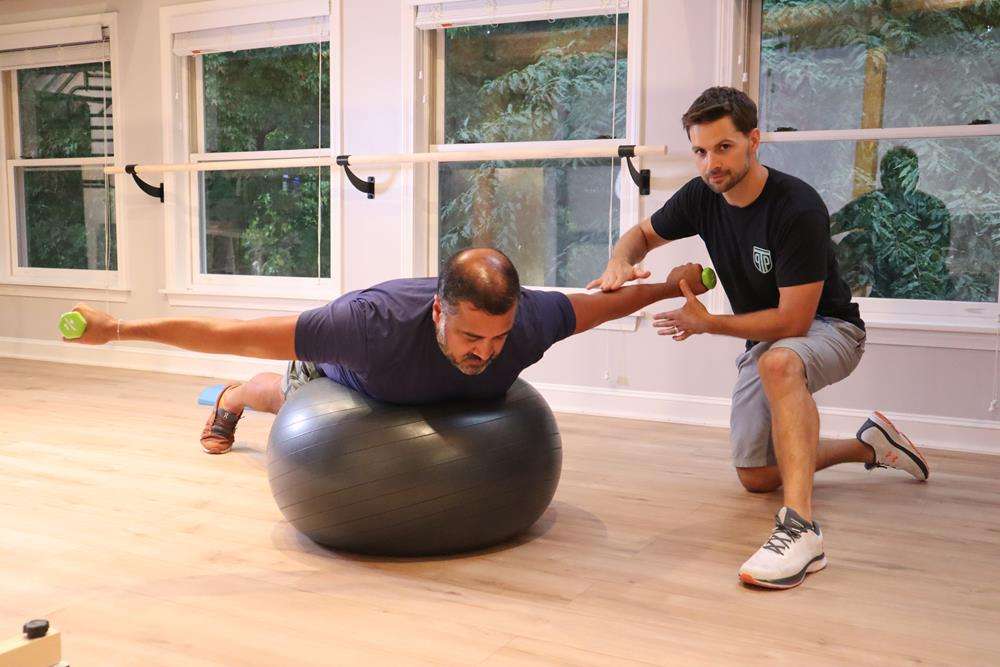
A Doctor of Physical Therapy coaching a core stabilization exercise on the stability ball

Where it leads

The goal is not only a lighter body. It is a stronger one that you trust to hike, ski, travel and carry what you want to carry for the next few decades. From here your plan continues into athletic development with the same clinician in the same facility, with the Annual Performance Assessment tracking your strength year over year, and Strong Bones if bone density is part of your picture. That continuity is the Progression Method.

GLP-1 and strength training FAQs

Do GLP-1 medications cause muscle loss?
The trials measured lean mass, not muscle. Lean mass on a body scan is everything that is not fat or bone mineral, so it counts muscle along with organs and fluid. In the main tirzepatide trial, about one quarter of the weight people lost was lean mass, and the split was the same in the placebo group. The trial's authors wrote that some loss of lean mass is expected with any substantial weight reduction. So the sources point to the amount of weight lost, more than to the medication itself. Because the total weight loss is large, the total lean mass lost can be large too, and that is the reason to plan for strength.
How much of the weight lost on a GLP-1 is muscle?
Nobody can give you one number. In a 140-person body scan substudy of the main semaglutide trial, people on the medication lost an average of about 18 pounds of fat and about 12 pounds of lean mass over 68 weeks. In the main tirzepatide trial, about three quarters of the weight lost was fat and about one quarter was lean mass. A 2025 joint advisory from four US medical and nutrition societies estimates that muscle is about half of lean mass. The popular line that 40 percent of the weight you lose is muscle comes from one substudy, and it describes lean mass, not muscle.
Does strength training prevent muscle loss on a GLP-1?
It has not been tested directly yet. We found no completed randomized trial of a strength training program in people taking semaglutide or tirzepatide, and a trial of exactly that question is under way. The case for strength training today rests on two things. In a trial of 160 older adults with obesity, the dieting groups that did resistance training lost less lean mass and less hip bone density than the dieting group that did only aerobic exercise, and they gained far more strength. And the 2025 joint advisory says these medications should be prescribed together with a structured exercise program that includes regular strength training.
Will I get weaker on a GLP-1?
The research does not show that people get weaker on average. In both main trials, people on the medication reported better physical function, on questionnaires, even though their lean mass went down. In a one-year trial of liraglutide, an older medication in this family, the medication alone did not improve physical fitness, and adding a structured exercise program did. What that adds up to: strength and fitness are the part you have to train for.
Is eating more protein enough?
The 2025 joint advisory says increased protein intake alone is likely inadequate to preserve muscle mass without structured strength training. How much protein is right for you is a question for your prescriber or a registered dietitian. Our part is the training.
What about bone density?
There is one randomized trial to go on, and it used liraglutide, an older medication in this family. Over one year, the people who took it without exercising lost bone density at the hip and spine compared with placebo, and the people who combined it with an exercise program held on to theirs, despite losing the most weight. The exercise was cycling plus circuit training, the trial was in adults 18 to 65, and its authors call the bone analysis exploratory. If you already have a low bone density result, see our Strong Bones program.
Should I change or stop my medication?
That is a decision for you and your prescriber. We do not prescribe, adjust or advise on medication, and nothing on this page is advice about starting, stopping or dosing one. We work alongside your prescriber on the part that is ours: your strength.
I have never lifted weights. Can I still start?
Yes. Every plan starts with an evaluation and with technique, taught light, before any real weight goes on. The joint advisory says exercise plans should be customized to match the individual's fitness level and physical capacity. That is how we work with everyone, and it matters most for someone who is new to lifting or has a joint that has kept them out of the gym.
Do I need a referral to start?
No referral is needed. Massachusetts has direct access, so you can start physical therapy without a physician referral. Tell your prescriber you are starting a strength program; we are glad to coordinate with them.
Do you take insurance?
We're an out-of-network, fee-for-service practice. That's what lets every visit be a full session, one-on-one with a Doctor of Physical Therapy, with no aides, no double-booking, and no visit limits set by a payer. Many PPO plans reimburse a portion of out-of-network care through the Super Bill we provide, and HSA/FSA funds typically apply. We'll walk you through what care costs on your free call.

This page is general information, not medical advice. We do not prescribe or advise on medication; decisions about starting, stopping or dosing a medication belong with you and your prescriber. Sources: Wilding et al., STEP 1 trial, NEJM 2021; Look et al., SURMOUNT-1 body composition substudy, 2025; Mozaffarian et al., joint advisory on GLP-1 therapy, 2025; Villareal et al., NEJM 2017; Jensen et al., bone health with liraglutide and exercise, JAMA Network Open 2024; Jensen et al., physical fitness with liraglutide and exercise, Sports Medicine 2026; Alawadhi et al., LEAN-PREP trial protocol, 2026; CDC, MMWR, GLP-1 medication use among adults, 2026.

Start with a free 15-minute call

Tell us where you are in your weight loss, what your prescriber has said about exercise, and what you want your body to be able to do. We'll tell you honestly whether we're the right fit, what the program looks like, and what it costs.

Request a free 15-minute call

Latest on Instagram

See the work, not just the words.

Real sessions from the clinic and the floor, 30 seconds each. New ones every week.

Follow @ptprogression