Does Your Young Athlete Have an Offseason?
- Give young athletes room to recover
- What the research tells us
- Build a schedule they can recover from
- How we can help
- Sources
Give young athletes room to recover
School season ends. Club season starts. Add private lessons and a few tournaments, and suddenly a 12 year old has a sports calendar that would make most adults tired just looking at it.
Parents want to give their kids every opportunity. It is easy to worry that taking a break means falling behind. But recovery belongs in a development plan just as much as practice does.
Sports specialization usually means focusing intensely on one sport for most of the year while limiting other sports. Having a favorite sport is completely normal. The concern is how much repetitive training fills the calendar, how well the athlete recovers, and whether they still enjoy it.
What the research tells us
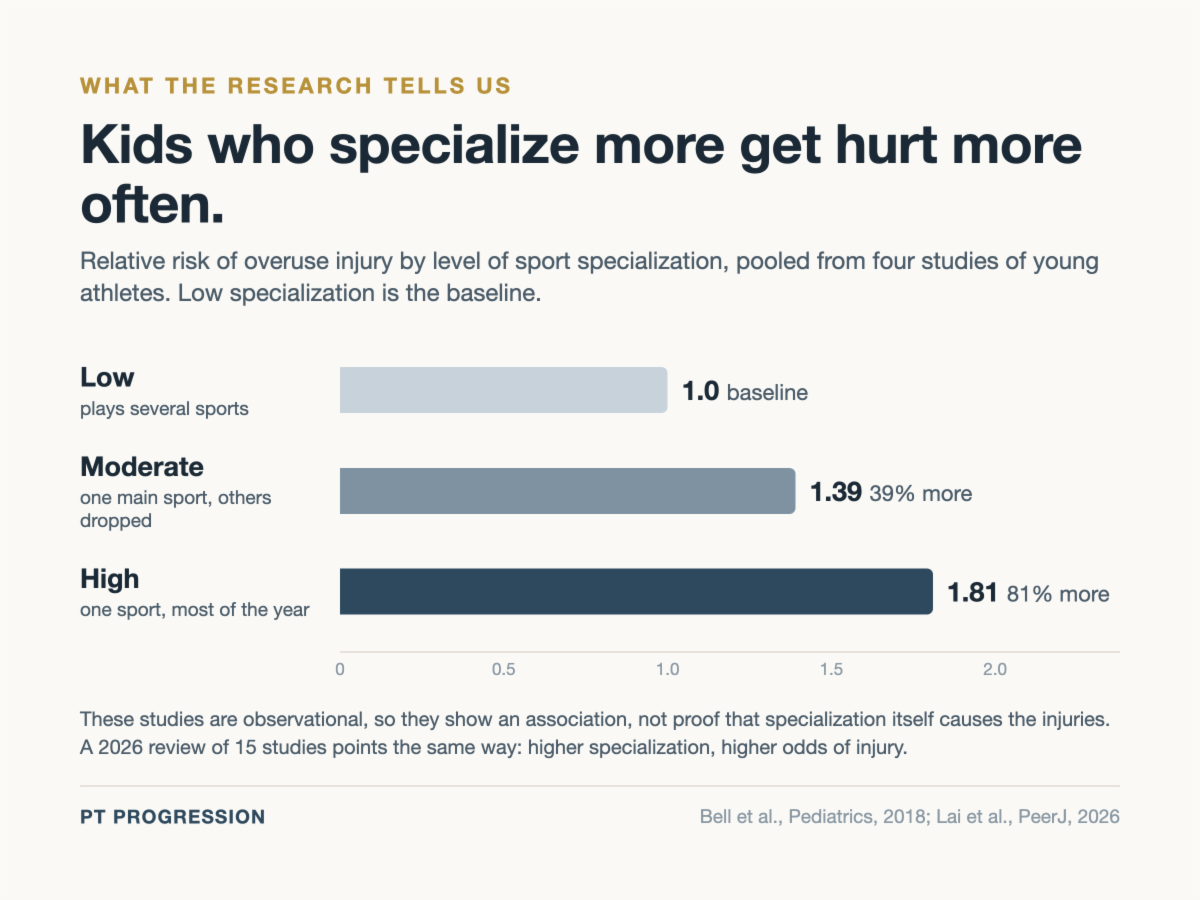
A September 2026 review of 15 studies found that greater sport specialization was associated with higher odds of injury in young athletes. The studies varied and were observational, so they cannot prove that specialization itself caused the injuries. The findings support being thoughtful about the training schedule. [1]
Playing several sports is not an automatic safeguard, either. Soccer, basketball, and private training can still add up to an overloaded week. Your child’s body experiences the combined workload, regardless of which team is on the schedule. [2]
For most sports, young athletes have time to explore before committing to one. That variety can include informal play, bike rides, or trying another sport. It does not require another expensive travel team. [3]
Build a schedule they can recover from
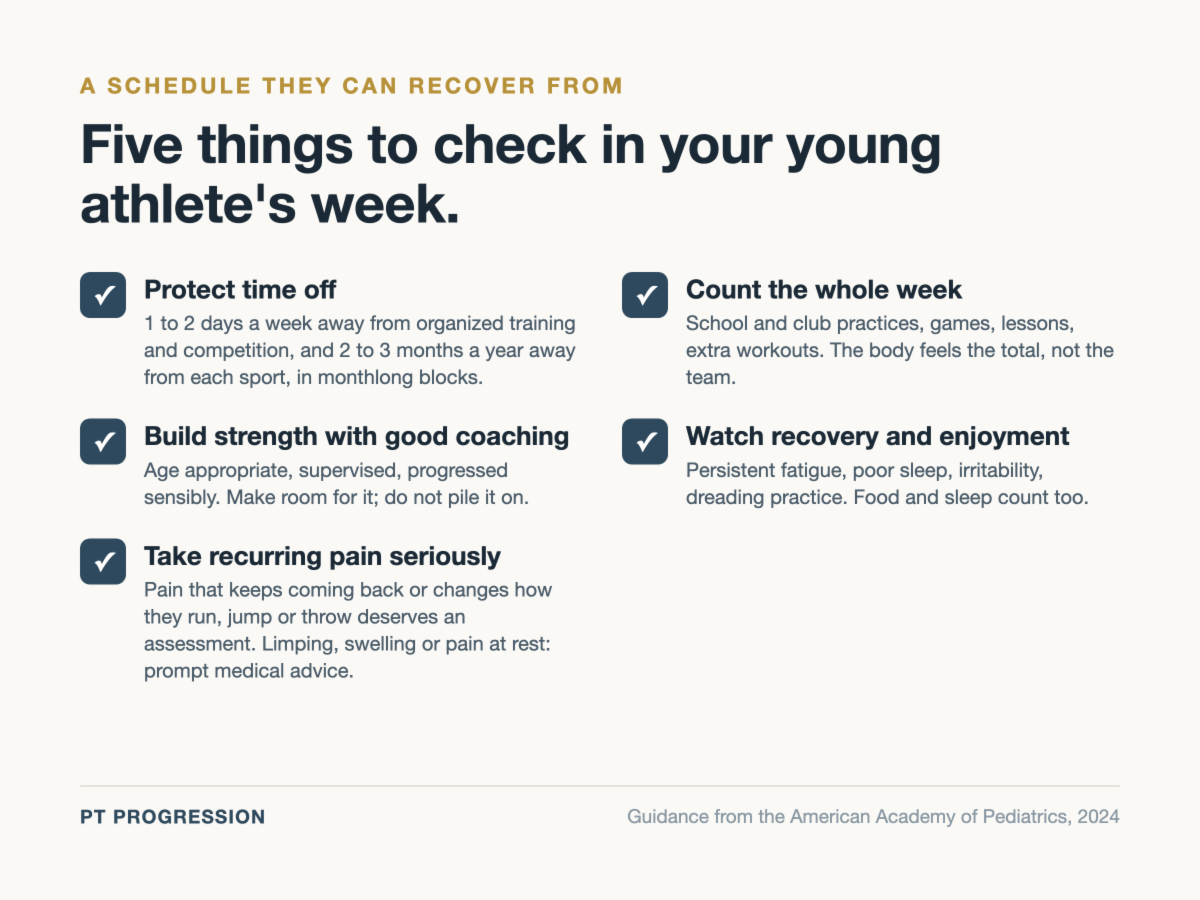
Protect time off. Aim for 1 to 2 days each week away from organized competition and training, plus 2 to 3 months away from each specific sport over the year. Those longer breaks can be divided into monthlong blocks. Other enjoyable activities can fill that time. [2]
Count the whole week. Include school and club practices, games, lessons, and extra workouts. Avoid piling another commitment onto an already full schedule. A sudden increase deserves a conversation with the coach. [2]
Build strength with good coaching. Age appropriate resistance training can improve strength and physical skills when it is supervised and progressed sensibly. Make room for it within the overall plan. Simply adding more sessions can defeat the purpose. [4]
Keep an eye on recovery and enjoyment. Persistent fatigue, poor sleep, irritability, or dreading practice can signal that the schedule needs attention. Enough food and regular sleep matter, too. Ask your child what they enjoy and what they would change. [2]
Take recurring pain seriously. Pain that keeps returning or changes how a child runs, jumps, or throws deserves an assessment. Limping, swelling, or pain at rest warrants prompt medical advice. [2,5]
How we can help
At PT Progression, we look at the athlete and the demands of their sport together. That includes symptoms, injury history, strength, movement, and the weekly schedule. We can help adjust training and build a gradual return plan, coordinating with coaches and medical providers when needed.
The goal is a young athlete who can keep improving and still wants to come back next season.
If your child has a nagging ache or you want help sorting out their training plan, request a free fit call or call (508) 650-1984.
Shawn
Sources
1. Lai G et al. Association between youth athletes’ sports specialization and injuries: a systematic review and meta-analysis. PeerJ 2026. Read the review
2. Brenner JS, Watson A; AAP Council on Sports Medicine and Fitness. Overuse injuries, overtraining, and burnout in young athletes. Pediatrics 2024.
3. Brenner JS; AAP Council on Sports Medicine and Fitness. Sports specialization and intensive training in young athletes. Pediatrics 2016. Read the statement
4. Stricker PR, Faigenbaum AD, McCambridge TM; AAP. Resistance training for children and adolescents. Pediatrics 2020.
5. DiFiori JP et al. Overuse injuries and burnout in youth sports: AMSSM position statement. Clin J Sport Med 2014.